Showing posts with label Distillery. Show all posts

Friday, December 7, 2012

Cardhu 12 Year Old Scotch Whisky Review:


If any distillery comes to mind when I think of my trip to Scotland with my wife it’s Cardhu. Situated in a cluster of five distilleries, right off the River Spey, Cardhu sits high above the glen in which the other four linger. One of the most beautiful and easily accessible locations in Speyside, Cardhu surprisingly receives fewer visitors than the hard to reach Talisker on the outer reaches of the Isle of Skye. Nonetheless, Cardhu is still Diageo’s best selling single malt (with Talisker right behind) where the designation is upheld by the Spanish market. Yet, unlike Talisker, or any of Diageo’s distilleries, the historical significance and the designation of Cardhu as the spiritual home of Johnnie Walker makes it a completely unique experience. Located under one of the twin pagodas, where malting used to take place, is a special room(s) dedicated to everything Johnnie Walker – a place to impress the who’s who of the whisky world. Even though it is closed to the general public, the reputation of the bed and breakfast my wife and I were working at allowed us the privilege of venturing inside.


However, I couldn't say I was dazzled or impressed with a sense of, "I'm being let in on a Johnnie Walker secret," or anything like that. The place did have lovely interior and there was one room which was a sort of library/museum for JW that had a fire place which looked comfy enough to snuggle up to with a nice dram, but we unfortunately didn't get offered any samples – free samples being quite the common occurrence everywhere else (or at least included in most tours). Either way I digress. The time spent at the distillery and the Johnnie Walker House next-door was all worth it and it will be a cherished memory. Not to mention the farm of highland cows feeding near the entrance. Sooo, what about the review:


Cardhu 12 Year Old Scotch Whisky Review:

Price: Around $45.00 for a 750ml bottle.

Packaging/Labeling: A unique bottle to say the least, but I love the large cork stopper.

Alcoholic Content: 40% abv, 80 proof.

Nose:  A balanced nose of sweet and substantial smoked green apple, overripe pear, and lemon zest. Malty grain and damp oak.

Palate: Gentle sweet/dry malt, not an overly sweet palate such as Aberlour. This is syrupy. The peat is pleasant, almost non-existent – Leaves you with a dry lingering peat. As time passed some of that dark fruit and wood begin to come through – so pour it early and let it develop.

Conclusion: Without getting into the discussion of Cardhu's mishaps a few years ago when they began blending their main label, the single malt version has made quite the comeback. This is an everyday dram. It is not overly complex, nor is it boring. You will know what you are getting every time. I would suggest this as something to start the evening with. It won’t blow your taste buds away but it will always be pleasing. Add one single drop of water and it will brighten up the nose and palate beautifully.

 How better to end a blog post with a real highland cow! I cleverly named him Johnnie.

Friday, March 9, 2012

For Portland/Oregon/Washington Whiskey Lover

Each year on St. Patrick’s Day McMenamins’ Edgefield Distillery releases a single edition 10 year old malt whiskey. They usually sell out around noon the same day, so if you want to grab a bottle (200ml) get there early. And yes, their whiskey is much better than their beer. Previous McMenamins' Reviews: One, Two, and Three.

Wednesday, February 22, 2012

Jameson Irish Whiskey Review:

"A man who stole my whiskey used the defense that no one could
 resist a bottle of Jameson. I had no choice but to testify on his behalf." 
- Jameson whiskey ad, found on a NYC Subway


By the 1800s Jameson was the most popular spirit beverage in the world next to Rum. Today it is still the most popular Irish whiskey in the world. Produced at Middleton distillery, one of the four distilleries in Ireland, over 14 million liters of this stuff is produced every year.  Yes, I said four distilleries. For the supposed birthplace of whiskey it is a sad story. At the beginning of the 20th century there were over 60, but as the story is for much of the spirits world, prohibition in the US and the temperance movement, along with the war of independence in Ireland, put the “kibosh,” as Ralfy says, on most of the distilleries in Ireland. Fortunately things are turning around in the world of whiskey in general – Killbeggan, the forth distillery in Ireland, only just reopened in 2007.

Ironically Jameson was founded by a Scotsman and the one bar which consumes the largest portion of the stuff is some Irish pub in Minneapolis (over 22 bottles a day in 2008!) – though I think the Buena Vista Café in San Francisco also comes close. Anyway, I have heard from other seasoned reviewers that 6-8 years ago Jameson was lacking when it came to expressing a true pot still taste. Since then I’ve heard it’s improved. I can’t really judge it on the past, but to give away the punch line, I do agree that this is much better than I would have expected, being that it is generally used for mixing with Coka-Cola. Whether it expresses a true pot still taste is highly debatable.

Today only the museum remains in Dublin where the old Jameson Distillery used to sit on Bow Street. There are no existing documentary records to prove it, but it is generally believed that John Jameson founded it right around 1780. John, being already part of the Haig Whiskey dynasty, was well positioned to start his venture. In fact his son married the daughter of Robert Stein, the man who invented continuous distillation. By 1902 the company became public and due to the family’s desire for a quality product, they began to mature their whiskey earlier than was the usual tradition. At the time whiskey was generally stored for short periods in the cask and drank fairly young (Maybe not quite unlike the practices of many micro-distilleries today?). Also to note, Jameson is known as one of the pioneers of aging products in sherry casks. So coming to the modern day, in 1966 Jameson, along with Powers and Cork Distillery, came together to form IDG (Pernod Ricard), thus moving production to its current home in Middleton in 1975. So enough history: how 'bout the whiskey?  

Jameson Irish Whiskey Review:
                                    
Price: Around $24.99 (give or take) for a 750ml bottle.

Packaging/Labeling: Hasn’t changed much – mass produced but ascetically it works fine.

Alcoholic Content: 80 Proof, 40% ABV. 

Color: Dark caramel – e150e. 

Nose: Light malt and fruity arrival. Green notes with dried rosemary leaves. Baked bread and oak. The nose is actually nicer/more pleasant than I would have expected but it does not have much going on – and I am not speaking of the fact that it is triple distilled, I take that into consideration.

Tasting: Light malt with much more caramel on the front and mid palette. Turns green with a bit of grainy sweetness. A drop of water does help round things out, yet it doesn’t wow the senses.

Conclusion: This is not bad, as some malt snobs would suggest, but it isn’t something I would consider a great purchase unless you're wanting to drink half the bottle during a wild evening or mixing it with soda – mixing this does work well. Will this ever be a basic staple or would it be what I think of as my heart grows warm and fuzzy while I read Oscar Wilde? No. For a true example of triple-distilled Irish whiskey I will suggest Redbreast 12 or Bushmills Black Bush – you can never go wrong with either.

Wednesday, January 18, 2012

Do Small Barrels Produce Inferior Whiskey?


In the last few years, with the explosion of micro-distilleries in the US, there has currently been a slew of blogs and articles flaying around debating the whole issue of small barrel aged whiskey verses large barrel aged whiskey. On one side of the argument you have a large majority of micro-distillers using 5, 10, and 15 gallon barrels to age their whiskey; think Tuthilltown. On the other side you have more traditional, and generally larger, distilleries aging whiskey in 48 and 53 gallon barrels; think Buffalo Trace. The question is: do smaller barrels produce whiskey, aged 2 years or less, similar or comparable to bourbon aged in, say, 53 gallon barrels for 8 years?  No matter what the outcome, it might seem insignificant at first, but the large scale effect of products claiming to be analogous (“as good as”) to mainstream bourbon or scotch, if they are actually inferior, could be devastating on the image of traditionally crafted bourbon or scotch style whiskies. I thought, rather than try and fully delineate my thoughts here, I would post a link to Chuck Cowdery’s blog post which deals with the exact subject at hand. I believe Chuck has a very clear understanding of the issue and I encourage all of you to download his (very) small book which details the whole argument in full - on Kindle for just 99 cents.

Photo Above: Tuthilltown 15 gallon Spirit Barrels, courtesy of The Spirit Review.

Friday, August 5, 2011

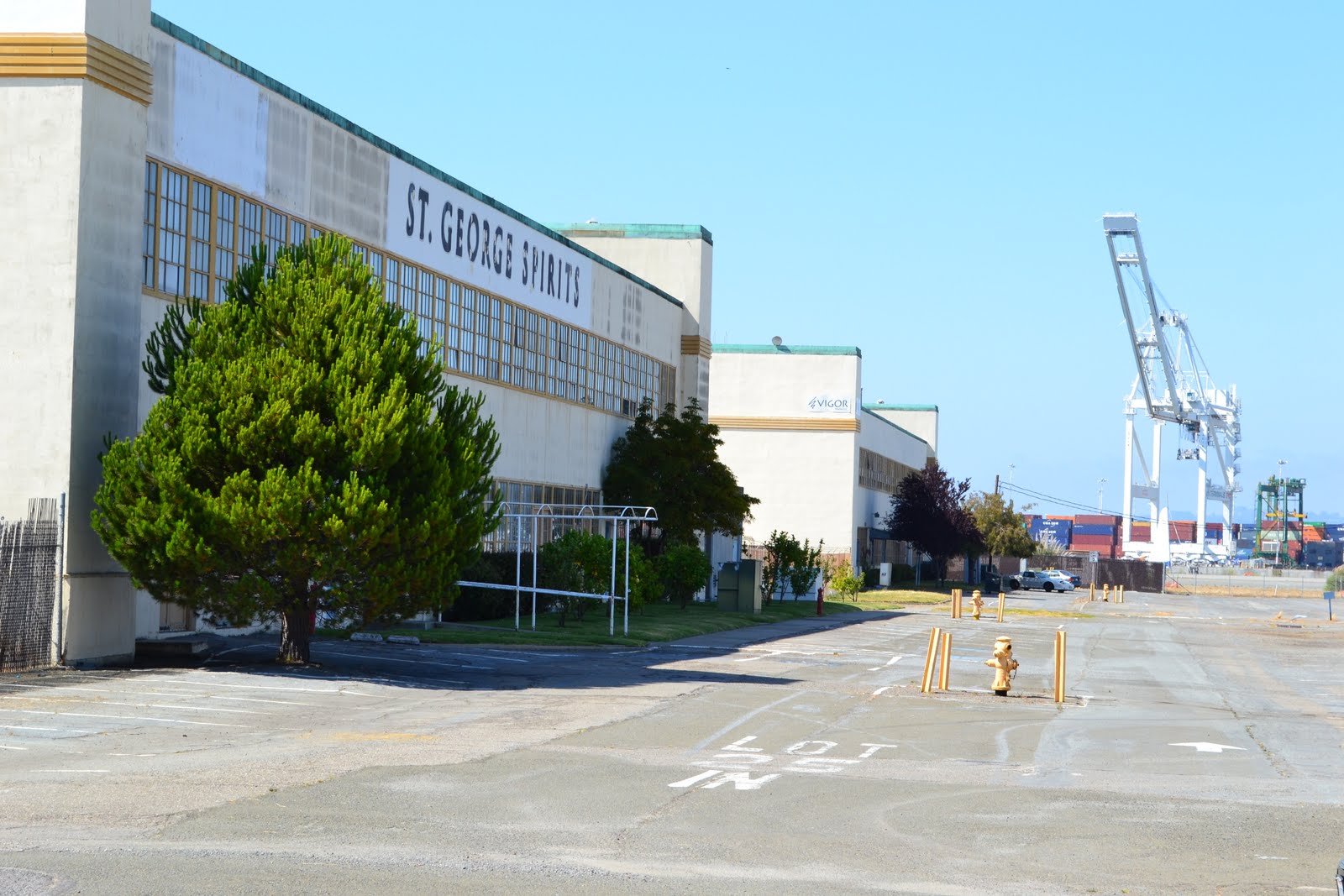
The St. George Distillery Tour: Home of Hanger One Vodka

"We can’t write like Neruda, paint like Cézanne, or dance like Jennifer Beals, but we can express ourselves through craft distillation. It’s our art form, our passion, and our way of making the world just a little more beautiful." - St. George Spirits


An unusual, but beautiful, view for a distillery:


St. George Bourbon, impatiently waiting to be released:

Their pet shark from the set of Deep Blue Sea (Link: Spoiler alert!):


In 1936 the City of Alameda, for the hefty sum of $1, transferred Alameda Point to the federal government of the United States. Known as the “Aviation Gateway to the Pacific,” Alameda Point was the perfect location for setting up an air force base in the tumultuous times of the 1940s. Decommissioned in 1997, the base became an ideal place for unassuming enterprises. One such enterprise was St. George Spirits who in 1997 moved into the beautiful 65,000-sqaure-feet Hanger 21 - though, 1997 was not St. George’s birthday. Jörg Rupf who had come to the Bay Area in 1979 to do post-doctoral work on a grant by the German Government started the company in 1982. Because of the lack of locally produced eau de vie, Rupf decided to leave his studies and open the first eau de vie distillery in the US. It was only in 2000 that Rulf and his new partner, Lance Winters - a former navy nuclear engineer and brewer, released their first bottling of single malt whiskey; and in 2002, their first batch of Hanger One Vodka, what would become their most praised and revered beverage to date. With 10 full time employees and 9 different products, each with multiple variations, St. George Spirits is a microdistilling powerhouse. 

Just from walking around this place one can see this distillery is not like the “rest of them.” From its giant shark, the mermaid hanging down from the mash tanks, and the tour guide which would fit better in a comedy club, St. George Spirits has a personality of its own. Is it exactly my taste (no pun intended)? Maybe not, but when push comes to shove I don’t really care about the personality of the distillery and the character of its staff. All I care about is the quality of the spirit. Is it made with care? Does it hold up when you begin comparing it with other similar products of quality? Not to mention, there is a place for diversity. One shouldn’t expect a loch outside the window of every distillery, or their water to flow in from the iron-free Cave Spring. There is a place for everyone and, as I just said, when it comes down to it, the product is left. There is room for novelty, but I don’t think this is the source of St. George's passion, practicing and refining the art of distillation is.

So what of it then? How did the tasting go? It was interesting. In fact, I hardly remember it. Why? Because after trying 15 different spirits in one sitting, by the time I actually tasted their bourbon my palate was ruined. If this was the "basic training" I would hate to see what it’s like for the "special ops." Why in the world, if you make an aqua perfecta eau de vie, multiple selections of vodka, a single malt whiskey, aqua perfecta fruit liqueurs and an absinthe verte, would you have someone taste them all in one sitting? I don’t have an answer. Coming out of the tour and tasting I almost felt like I was being swept through the place rather then feeling like a valuable customer who they wanted to educate about their product. 

So what am I saying? Am I giving a negative review of the place? No. The guided tour was a terrific and hilarious experience. One whole hour for a free tour is something you don't get every day - and you come out having learned a lot. The only issues were the excessive amount of spirits for the tasting and the server seemed a little inexperienced - I would say it was a noticeable problem when she didn't even know there was bourbon set to be released, stacked directly behind her in the adjacent room (only having been in the barrel for the last 5 years!).

My suggestion for the tasting would be to limit it to about four or five spirits at the most and provide more time for discussion on the actual tasting of each individual drink, allowing for each participant to not only learn about the spirit, but also to gain a valuable experience in tasting. You don't need to show someone everything on God's green Earth to get a customer to come back. Show them the quality of a few products and allow them to recognize the quality, and from there they will not only keep coming back to St. George Spirits, but they will also be more wiling to try the larger selections St. George offers. Rushing a group through all of them will leave a person with little to go back to - overwhelmed and under appreciated. All in all I would still recommend you visit the place if you're in the Bay Area.


In 2007 St. George released the first absinthe in the U.S. since 1912:

Sunday, June 19, 2011

The Edgefield Distillery Tour:


"Too much of anything is bad, but too much 
of good whiskey is barely enough."
                                  -Mark Twain

Located in Troutdale and designated a National Historic Landmark, McMenamin’s Edgefield comfortably sits on a 74-acre tract which use to house the county poor farm. Perfectly situated just 13 miles from downtown Portland and just on the cusp of the Columbia River Gorge, one can tour the numerous falls which dot the historic highway or take a quick drive into Portland for a day of sightseeing. 

Nonetheless, even with Multnomah Falls and Downtown Portland having plenty to offer, the real motivation for someone choosing to stay at Edgefield is precisely Edgefield – a destination in-of-itself. Built for the very reason to showcase the grandeur of the McMenamin’s Empire, Edgefield is the McMenamin’s Brothers crown jewel and it is awesome. One can spend hours (days), literally getting lost through pub crawling many of the ten distinct and unique bars, watching a movie in the theater, playing golf on one of the two par-3 courses, getting a full spa treatment and spending time in the giant outdoor soaking pool, wine tasting in the winery, smoking cigars in the cigar bar, or just simply hanging out on one of the large porches or picnic areas strewn throughout the campus.

It is here at Edgefield where they produce their wine, much of their beer, and most importantly to myself and this blog, their spirits. Opening its doors in 1998, the Edgefield Distillery has built production up to a number of gins, brandies, whiskeys, and liqueurs. Considered one of the preeminent micro-distilled whiskeys in America, their Hogshead Whiskey is what has brought McMenamin’s Distillery into the light. Of which I will have a review of both the Hogshead and its much younger version of itself, the White Dog.

The Edgefield Distillery is located near the south end of the Edgefield campus housed in a converted dry barn which was originally used to store vegetables during the poor farm days. Surprisingly the space is fairly small for such an operation – but the aesthetic quality of the converted barn is fabulous with the woody aromas of the constructed barn mixing with the current fermentations and distillate. Packed full of old mash tanks which use to be used for their beer production they now hold distillate in various stages. During my tour I was fortunate enough to observe the current distillation of their rum production as well as nose its head. Don’t get me wrong, the process of distillation, once it’s in the still, is akin to watching water boil, literally. But the scent of the rum distillate, which at the time of my tour was at about the center run of its heart, smelled amazing. On the first step inside not only does one get the bready smell which is common in a distillery, but also present was a sugary-sweet fragrance which comes from the sugar-cane molasses used in rum production.


Near the end of the tour, while I was being shown the barrel room which is also a surprisingly small space for the amount of spirits they produce, I was told that the Hogshead whiskey, of which I purchased, was bottled at about 37 months. Their goal, the head distiller explained to me, was to eventually reach five years in the barrel. Leaving the tour I could defiantly say I was, and am, excited to try this barely three year old spirit which is something quite unique which will not, in the present future, be available again.