Showing posts with label Scotch Whisky. Show all posts

Monday, January 6, 2014

Ardbeg 10 Year Old Single Malt Scotch Whisky Review:

As reviewed first through my instagram: @lifeofawhiskeydrinker


Ardbeg 10 Year Old Single Malt Scotch Whisky Review:

Price: Around $50.00 for a 750ml bottle.

Packaging/Labeling: Iconic, with a craft presentation stating it is non-chill filtered.

Alcoholic Content: 46% abv, 92 proof.

Nose: The nose is a peat and iodine bomb. Winter notes of briny pepper, citrus, and vanilla. Reminds one of cold walks through the neighborhood when you can smell all the chimney smoke.

Palate: The palate is a blast of eucalyptus and peat. Wonderfully balanced. Salt and sea. Peppermint tea with lemon. A long finish with salted caramel and smoke.

Conclusion: For those winter days where you need the cold knocked out of you, this non-chill filtered Islay classic is the perfect choice.


Rating: Excellent/Highly Recommended

Friday, September 27, 2013

Springbank 10 Year Old Single Malt Scotch Whisky Review:


For the majority of us who are only relatively aware of our options out there when it comes to single malt whiskies, the malts from the Campbeltown region of Scotland are somewhat allusive. Holding more to legends than to real facts, the Campbeltowns could be compared to what the rye whiskey used to be in the western United States during the 1800s, everywhere and in abundance. From the 1800s up until the 1900s the distilleries of Campbeltown were the most prolific whisky producers in the country with a record breaking 28 facilities producing. But due to over investment in the pre-prohibition American whiskey trade, local depression during, and a reputation for poor product throughout, Campbeltowns former glory faded into the past like the ryes of the old west. Only Glen Scotia and Springbank remain. But thankfully they do, because the characteristic dry palate of smoke and salt from a good Campbeltown is part of what makes these malts so exciting.

Specifically, Springbank is a fantastic example of a small size and independent producer. Possibly because of their historical involvement with Campbeltown, Springbank has grown in a way that lies outside the scope of many of the larger producers, always centering towards practices that produce whisky in the “old fashioned” way and not changing how they do things for a larger consumer market. From malting their own barley to bottling their own whisky and employing a local workforce, Springbank offers lessons that all the larger producers can learn from.

As fair warning, I will say that if you have arrived at this review and you have never yourself tried Scotch, or you are still relatively new to the whisky scene, Springbank is not for you. It very well may be a bit difficult to get past. In this section I detail some scotch whiskies that could be very great starters. But by all means, never let me stop you... Shall we continue?

Springbank 10 Year Old Single Malt Scotch Whisky Review:

Price: Around $45-52 for a 750ml bottle.

Packaging/Labeling: A craft presented bottle where they explain in plain english that they do not use caramel coloring and there is no chill filtration. What we like to see!

Alcoholic Content: 46% abv, 92 proof.

Nose: There is a maturity of the nose, even at 10 years old. Brininess hits your senses first. Sweet butterscotch and cream. Chocolate covered cherries. Salt and pepper spice. Everything you receive in the nose is a real pleaser. A nice complexity that genuinely gets me excited for the tasting. Adding water really brings down the brininess and allows for the subtle fruits to show.

Palate: Large spice arrival. Oily and faint smokiness. Ginger spice, light vanilla and honey, peppers, oak, seaweed. With the non-chill filtration a little addition of water allows for the fruit and black liquorice sweetness on the backend to come to the foreground. Bit of a dry finish.

Conclusion: At 10 years old, I don't know what else I can say. This is a fantastic dram, one that thoroughly invigorates my senses. If this is a tiny inkling of what we are to see with the older Springbank's, it should really get one excited.

Rating: Excellent/Highly Recommended

Friday, September 6, 2013

High West Campfire Whiskey Review:


I know, I know! No reviews in almost a month. This isn't how I ever want things to go. I've been busy and a bit sick, so high proof alcohol hasn’t been treating my throat very nice. But alas, there is a light at the end of the tunnel. There are some genuinely exciting changes coming up for the Bourbon Intelligencer that will guarantee more reviews and whiskey content for the foreseeable future. But that is all I can say on that for now. You'll just have to wait for more news. Updates will be coming possibly within the next month or so.

Tonight we've got with us a truly revolutionary product from High West Distillery: Campfire. This thing breaks all the rules and does so with poise and courage – yes... courage. I feel that good whiskey calls for the assigning of virtuous nouns. Campfire is composed of three whiskies: a 5 and a half year old rye distilled at MGPI, a six year old bourbon also from MGPI, and finally an 8 year old peated Scotch. Where the peated Scotch is from, David Perkins at High West does not divulge, though we do know it is not from Islay or the Islands. Ultimately I am not too concerned with the origin – High West has up to this point always been straight forward with their practices and this thing is so damn delicious that we don't care too much to ask.

High West Campfire Whiskey Review:

Price: Around $50.00 for a 750ml bottle.

Packaging/Labeling: Classic High West – the necessary information included.

Alcoholic Content: 46% abv, 92 proof.

Nose: More of a honeyed and fruit nose than I expected. Dried golden raisins, toffee, cinnamon, vanilla. Only on the back end do you find traces of scotch and rye. A hint of smoke that lingers on your jacket after a weekend of camping. Sweet green apples.

Palate: Quite unique indeed. The scotch does seem to play second fiddle to the American spirits here, but the balance of all three seems to work out wonderfully. The smooth and creamy dried fruit of the bourbon, with the spice and pepper of the rye, leads very nicely into the sweetness and peaty twist of the scotch, which allows itself to be ever so present throughout.

Conclusion: High West has really done something unparalleled again. And in many ways, the name fits even better after trying it. This is not necessarily a bold and overbearing whiskey in any sense of the word. It's calming and delightful. That's what I meant by poise and courage. This experiment could have been anything, but High West took the high road and has shown they are always taking their time, always honing their craft.

Rating: Excellent/Highly Recommended

Wednesday, July 31, 2013

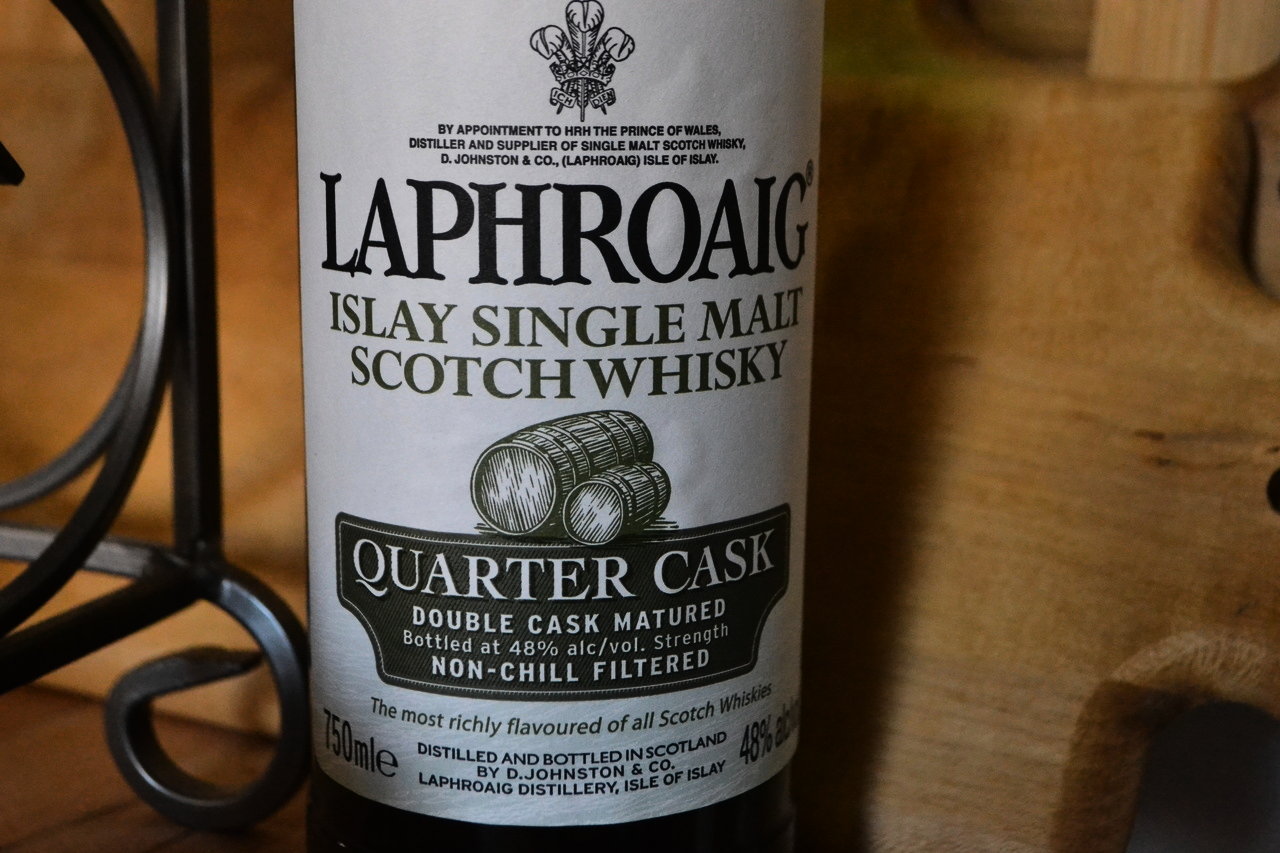
Laphroaig Quarter Cask Single Malt Scotch Whisky Review:


There are haughty eyed consumers in every sector of the beer, wine, and spirits industry. Really snobs can be found in any industry of higher end consumer goods. Yet within the world of spirits it would be safe to say that Islay whiskies drinkers tend to have the largest majority shareholders of braggadocios. In a way it makes sense.We all know, or knew, how it was when we first found a taste for the peaty liquor. At the beginning there was some sort of barrier between you and that bottle of Ardbeg 10 staring down from the upper shelf of the bar. That huge phenolic blast that hits you when you opened up your first bottle. Those campfire fumes you could smell clear across the bar where the one person has ordered a double of Caol Ila 12. Plain and simple: Islays are intense, unique, and at times illusive with their dark bottles and strange names. So naturally when a certain person at last succeeds at conquering this chimerical style of peat and smoke, a certain air of pomp and circumstance inflates there chest whenever they walk into the bottle shop, so sure of themselves as they walk straight toward the Islay's and past.... well, past everything else. And for this very reason I have been hesitant to review largely peated whiskies until now. I have learned to enjoy peated whiskies immensely, especially over the last two years, but I have always been leery of focusing too much on them, just as I have been mindful of how much focus I give to any style of whiskey or spirit. So at last the time has come – and Laphroaig Quarter Cask, in my mind, seems to be the best tie in for an introduction to Islays in general for the blog. The style is young and vibrant, providing a classic Islay profile, yet the partial use of smaller cask in maturation provide a contemporary, à la an ancient, way of maturation, which relates perfectly to the modern day discussion of small barrel maturation in the micro-distilling industry.

Aged about 8 years, this expression is filled in second fill oak barrels for the majority of maturation, then moved into and matured in smaller quarter cask (40-55 liters), as were used for transport in the “earlier days.” Smaller barrels means more wood/whisky surface area contact and more air interaction as the cask “breaths,” hence “faster” maturation – but only faster in one sense as I have explained in other posts. The difficulty that micro-distillers are finding as they age their whiskey solely in small casks is a lack of balance which larger barrels tend to provide. But with the Quarter Cask expression, the younger age in the larger barrel provides a youthful peatiness, and the quarter cask rounds out the aging process to provide some “wear and tear” of old age.

Laphroaig Quarter Cask Scotch Review:

Price: From $59.99 for a 750ml bottle.

Packaging/Labeling: All the necessary information and more. Everything we like to see on a “craft” expression. Green bottle means there is no need for caramel color (e150e) to be added. Non-chill filtered. Perfect.

Alcoholic Content: 48% abv, 96 proof.

Nose: Fresh peat, briny seaweed, stone and rock on ocean cliffs. Floral milk chocolate, syrupy caramel.

Palate: Incredibly delightful. I think of someone who is, though young, well spoken and confident. The buildup is smooth an gentle, from a sweet pepper introduction developing into a a huge peat monster wallop. Iodine and Smoke. Long lasting peat finish which prickles on the back of your throat.

Conclusion: What you get from this younger whiskey is not something overly complex, but rather a product where its gears are tightened and oiled. The nose, buildup, and arrival, provide ample excitement and enjoyment that will keep you coming back for more. This is what a young single malt should taste like. A successful and well articulated experimentation of differing size casks, and a whiskey that gets one excited all over again!

Rating: Excellent/Highly Recommended

Monday, May 13, 2013

Ardmore Traditional Scotch Whisky Review: Another Meaty Malt


Some whiskies are made to be consumed as they are – a pure unadulterated piece of craftsmanship. Others are produced with the intention of being blended with other whiskies – to create something that is greater than the sum of its parts. Yet every so often the latter kinds of whiskies are produced in such a way that they break free from their sole use as a blending devise. Every so often during the early stages of a distilleries conception, the producers discover that they are creating something which can hold its own among other single malts, while at other times it takes years for a label to break free of blender status. It was such with Ardmore, taking almost a century from its beginnings to finally being released as a single malt. Founded by the Teacher’s Family in the late 1800s, the Ardmore Distillery was originally produced to be used as a fundamental malt for the Teacher’s blends. As was traditional back in the day with most Speysider and Highland malts, Ardmore was peated around 12-14ppm (for reference Talisker on Skye is currently around 18-20pm). That being said, the times of peaty Speysiders is long gone, leaving Ardmore as a bit of an exception.

Today we are looking at the core “Traditional” expression. Non-chill filtered and peated with no age statement, but made of mostly ex-bourbon cask from around six to thirteen years old. Once the malt has been vatted, the whisky is then filled into quarter cask for one more year of maturing and finishing. 

Ardmore Traditional Scotch Whisky Review:

Price: Around $41.00 for a 750ml bottle.

Packaging/Labeling: Nothing to write home about, but the bottle is informational, clean and modern, which means I can’t complain.

Alcoholic Content: 46% abv, 92 proof – not bad!

Nose: A creamy and full nose. Peat and smoked fish. Well balanced and tight with strawberry malt flavors. The meatiness and the more softer notes blend very well together.

Palate: The nose is quite indicative of what’s to come. A buttery palate coats the tongue where it releases all its sweet and savory juiciness. There is a nice little spicy vanilla kick on entry, ending on the back with peaty sweetness. I do feel that some of the younger cask come through on the end palate allowing, in my mind, a bit too much green-ness.

Conclusion: Unintentionally this is another unusual whiskey for where it is located. This is not nearly as fantastic as the Mortlach but it is a unique and solid single malt that can easily be found in the US, unlike the former. If you are looking for some similar single malts look either at Bowmore (with a higher ppm of around 25), or across the way in Ireland, at Connemara Peated 12 Year Old. Ultimately really enjoyed this expression of Ardmore and you won’t be let down with a purchase of it yourself I’m sure.

Tuesday, December 11, 2012

Oban 14 Year Old Scotch Whisky Review:

Whenever someone asks me if I want water with my Scotch
I say I'm thirsty, not dirty. 
– Joe E. Lewis


Oban, one of my most cherished distilleries in Scotland, is located in the west-coast highland town of Oban (pronounced O-bin). It is the largest town on the west coast and it is an easy stop for those driving up to the northern Isle of Skye making it the second most visited distillery for Diageo, with over 32,000 visitors a year. Interestingly, the city of Oban was never a city before the distillery was opened in the late 1700’s. Only once the distillery was built, did a town begin to form. The distillery meant jobs and its location on the coast meant a shipyard. From there it continued to grow and flourish as it built itself up around the distillery. Thus Oban is quite unique in that it cannot grow from its present size of four washbacks and one pair of stills. There just isn’t any room. Though, even for the small size of the distillery it would seem rather odd that at full capacity it would be producing upwards of about 700,000 litres a year. The pair of stills could allow for more but there is a bottleneck in the washbacks. Oban's unique flavor profile is dependent on a very long fermentation period (about 4 1/2 days), which translates to about six mashes a week. Inadvertently this means that there simply isn't a lot to go around. The 14 year old, reviewed below, is the only standard bottling, with the hard to find distillers reserve, limited editions, and an 18 year old released exclusively for the US market.


Oban 14 Year Old Scotch Whisky Review:

Price: Around $74.00 for a 750ml bottle. Expensive no doubt, the size and availability of the spirit justifies the price.

Packaging/Labeling: Fairly traditional bottle; clean, neat, and classy with a nice corkstop.

Alcoholic Content: 43% abv, 86 proof. 

Nose: Strong spearmint with a smoky mineral arrival. Peppermint and fresh cut wood with honey. Light notes of dark and tart fruit.
 
Palate: Bittersweet and malty on arrival. Smooth dark oak and light smoke. Nutty ginger, citrus, and salt on the end which develops into an almost bitter spice and drying finish. To note I find the bitterness, though a bit off putting to some, quite enjoyable.  Fresh cut leather lingers on.

Conclusion: Ahh, I just love this one. The bittersweet and salty is a wonderful mouth feel. Just enough peat for those who need it, and a comfortable amount for those who don’t. For $74.00 I find this well worth the money. Everything I could want in maritime malt. I do have to say that the whole time I'm sipping on this my mind is wondering what 4 more years (as in the 18 year old) could do for this – really enjoyable. If you're having seafood tonight, Oban would be a great accompaniment. Highly recommended.